
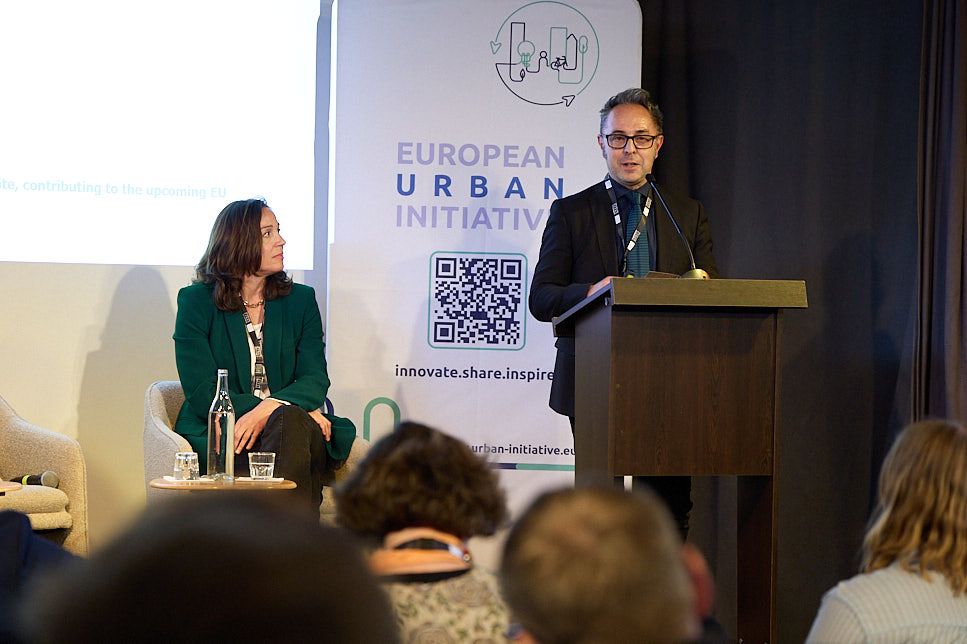
In April 2026, Zentropy MICE took part in the EUI Focused Policy Lab on Sustainable Tourism, held in Copenhagen and organised by the European Urban Initiative (EUI).
The event brought together European institutions, cities and urban practitioners to explore how tourism can evolve towards more resilient, climate-neutral and citizen-centred urban models.
Zentropy MICE’s participation was featured in a dedicated analytical article published on PORTICO, the knowledge-sharing platform of the European Urban Initiative. The article highlights how the project is contributing to emerging European policy debates by testing new governance models for sustainable MICE tourism grounded in the concept of urban entropy.
From tourism management to tourism governance
One of the key messages emerging from the Copenhagen Policy Lab was the need to move beyond traditional tourism management approaches. Discussions emphasised tourism as a transversal urban system, interconnected with mobility, housing, public space, climate adaptation, local economies and citizen wellbeing.
Within this context, Zentropy MICE was presented as a practical example of how Innovative Actions supported by the European Urban Initiative can help cities prototype and progressively integrate new governance frameworks into long-term municipal policy. The project positions tourism not as a standalone economic sector, but as a lever for wider urban transformation.
Urban entropy as a framework for sustainable MICE tourism
Developed in Valencia under the EUI Innovative Actions programme, Zentropy MICE introduces the concept of urban entropy to rethink the relationship between congress tourism, the city and local communities. Rather than focusing solely on environmental impacts, the project addresses the interaction between energy, matter and information flows generated by events and their exchanges with the urban ecosystem.
During the workshop on climate-resilient destinations, Zentropy MICE was presented as an experimental governance model. It links circular economy solutions, sustainable mobility, behavioural change and long-term legacy.
A key innovation is the entropy calculator, currently tested through pilot congresses. The tool measures environmental indicators such as mobility, energy use and waste. It also captures social and knowledge exchanges between events and the city.
Behavioural change and community engagement
The Copenhagen EUI Focused Policy Lab on Sustainable Tourism exchanges also highlighted the growing importance of behavioural change as a core component of sustainable tourism governance. Beyond technological solutions, cities emphasised the need to influence how visitors interact with urban environments and local communities.
In this context, Zentropy MICE is evolving its initial social currency concept towards a broader behavioural incentives and local engagement framework, inspired by exchanges with other European initiatives discussed during the Policy Lab. This approach aims to encourage sustainable mobility, participation in neighbourhood experiences and stronger links with the local economy.
Positioning Valencia in the European policy debate
According to the PORTICO article, Zentropy MICE’s contribution goes beyond technical innovation. The project demonstrates how congress tourism can become a tool for urban regeneration, local value creation and climate resilience when embedded in integrated governance systems and long-term strategic thinking.
At a time when European cities are seeking new models to balance tourism attractiveness with liveability and sustainability, Zentropy MICE positions Valencia not only as a testing ground for innovation, but also as an active contributor to the future European debate on sustainable urban tourism governance.
View full article written by Contreras Escribano, Ana (April 22, 2026). Zentropy MICE at the EUI Focused Policy Lab on sustainable tourism, Copenhagen April 2026. PORTICO.