
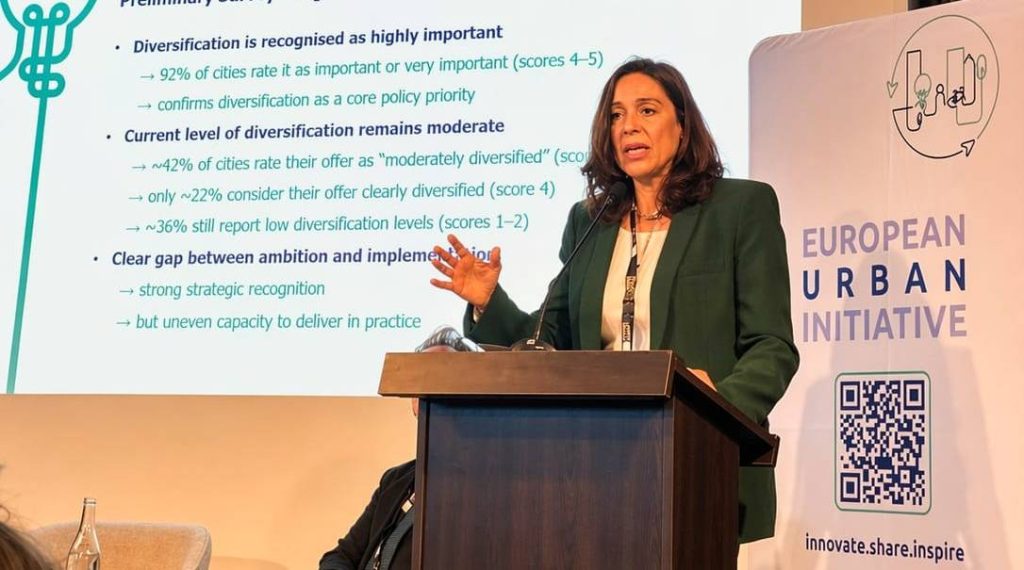
On April 22 and 23, the city of Valencia participated in the EUI Focused Policy Lab in Copenhagen, an event organized by the European Urban Initiative (EUI) as part of the European Union’s Urban Agenda, which addresses the challenges of sustainable tourism and its impact at the local level. The meeting aims to identify best practices and opportunities for improving multilevel governance processes in urban settings.
Valencia’s participation highlights European recognition of its sustainable urban tourism strategy and its alignment with other leading cities working towards a more balanced, resilient and people-centered tourism model.
Dialogue with the European Commission and progress as a sustainable urban destination
Valencia has been selected by the Sustainable Tourism Partnership to participate in the European Commission’s technical dialogue with urban stakeholders, a forum where relevant policies for the upcoming EU Strategy for Sustainable Tourism are discussed and the work of the EU Urban Agenda Partnership on Sustainable Tourism, launched in 2023, is analyzed.
The choice of Valencia to present the results of the Partnership on tourism diversification underlines Valencia’s role in balanced tourism management and its progress as a sustainable tourist destination within the EU policy framework.
This first technical-political dialogue with the European Commission has provided a unique opportunity for cities to share their challenges and opportunities, but also to present solutions and good practices that can help shape the next steps at EU level.
Valencia, a European case study in sustainable urban tourism
On Thursday, April 23, Valencia was presented as a case study, given its leading position in Sustainable Urban Tourism, delving into a comprehensive sustainability strategy that has allowed it to build a more resilient destination in the face of climate change.
Thanks to the implementation of the Zentropy MICE project, Valencia is exploring new tourism models where the impacts of events are integrated and offset in the city’s urban ecosystem.
With a clear commitment to circularity and the diversification of flows, Zentropy MICE represents a qualitative advance in the way MICE tourism is approached, positioning Valencia as a benchmark city in the sustainable and responsible management of tourism activity, with a model that generates positive impacts on the economy, society and the urban environment, and creates a legacy in the city and its citizens.
A replicable model in Europe
The EUI Focused Policy Lab is organized in coordination with the city of Copenhagen and constitutes a space for joint reflection where cities, professionals, representatives of the Partnership for Sustainable Tourism of the European Union Urban Agenda and the European Commission reflect on how to promote a more sustainable, competitive and citizen-centered tourism model.
Promoted by the Tourism and Innovation Department of the Valencia City Council, in collaboration with València Innovation Capital, the Valencia Conference Centre, the University Polytechnic of Valencia, the Fundació Visit València and the urban innovation studio Khora Urban Thinkers , Zentropy MICE proposes a circular model that pursues a state of ‘zero entropy’, in which the impacts generated by MICE events are transformed into positive returns in the form of knowledge, innovation, social cohesion and citizen well-being.
Zentropy MICE offers a model that can be extrapolated to other European urban contexts, with transfer partners such as Ljubljana (Slovenia), Heidelberg (Germany) and Larissa (Greece), who are already analyzing the replicability and scalability of this initiative that balances economic activity, social cohesion and environmental sustainability.
Zentropy MICE project has a duration of three and a half years (until May 2028), and has an approximate budget of 5.2 million euros, co-financed 80% by the European Regional Development Fund (ERDF) through the European Urban Initiative (EUI).