
How can cities and event organisers better understand the real impact of conferences? And how can they measure not only environmental performance, but also the long-term value events create for host destinations?
These questions are at the heart of two new scientific contributions presented by Zentropy MICE at the international Zero Carbon Built Environment 2026 conference in Lisbon. Developed by researchers from the Universitat Politècnica de València (UPV), the studies introduce innovative approaches to assessing the sustainability and urban legacy of conferences and professional events.
Together, they represent an important step towards developing new tools that help destinations and organisers design more sustainable MICE events while maximising their positive impact on cities and communities.
Moving beyond carbon footprints
Traditional sustainability assessments often focus on carbon emissions alone. However, conferences and events generate a much wider range of impacts, from resource consumption and mobility patterns to knowledge exchange and collaboration.
The first study, Entropy-informed circularity metrics for MICE tourism: systemic framework and case study applied to HERITAGE2025 in Valencia, proposes a more comprehensive approach to evaluating conference sustainability.
The research introduces the concept of exergy, which measures the quality of resources used throughout an event. This enables impacts associated with accommodation, urban mobility and catering services to be assessed within a common framework.
In addition, the study incorporates the concept of urban negentropy, an innovative indicator designed to capture the positive value events can generate through knowledge creation, stakeholder collaboration, economic activity and alignment with urban development strategies.
HERITAGE2025: testing the methodology in Valencia
The methodology was applied to HERITAGE2025, a conference held in Valencia, where researchers quantified the resources associated with attendees’ tourism-related activities and identified accommodation as the main contributor to the measured impact.
The case study demonstrates how destinations can better understand the different factors shaping conference sustainability and provides the foundation for future decision-support tools that help reduce environmental impacts while increasing value creation for local communities.
Building the future Zentropy MICE entropy calculator
The second research contribution focuses on one of the project’s most ambitious developments: the future Zentropy MICE entropy calculator.
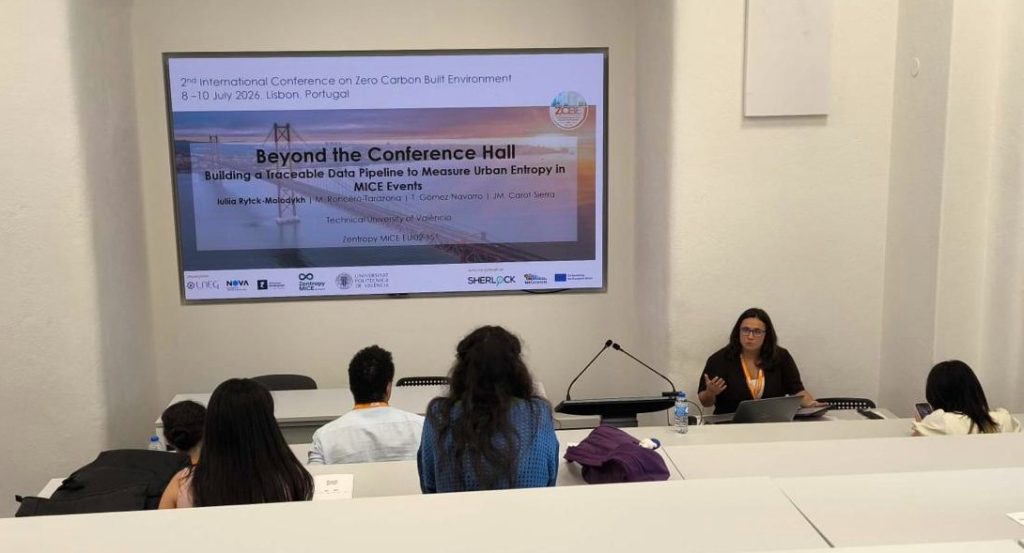
Presented in the paper Beyond the Conference Hall: building a traceable data pipeline to measure urban entropy in MICE events, the study addresses the technical foundations required to measure the impact of events on urban environments in a robust and transparent way.
The objective is to create a tool capable of integrating information from multiple sources and transforming it into evidence-based indicators that can support data-driven decision-making.
A new framework for measuring urban impact
To achieve this, researchers developed a data architecture capable of combining information from attendees, event organisers, venues and other urban data sources.
The methodology reconstructs the flows of energy, materials and information generated by an event and transforms them into measurable indicators.
A key innovation is the creation of a traceable and reproducible data-processing pipeline, allowing different datasets to be validated, harmonised and compared consistently. This helps ensure that future assessments are transparent, reliable and scalable across different events and destinations.
Tested in a real conference environment
The methodology has already been tested in a real-world setting during the IWA SERAM 2026 conference at the Valencia Conference Centre.
During this real-world test, researchers combined participant survey data with building energy information to validate the operation of the system.
The results demonstrate the feasibility of creating integrated assessment tools that enable organisers and cities to compare alternative event management strategies and identify opportunities for improving sustainability performance.
Towards a new generation of events with positive urban impact
Together, these two studies reinforce Zentropy MICE’s ambition to transform how conferences and professional events are evaluated.
Rather than focusing exclusively on what events consume, the project seeks to understand both their environmental footprint and the long-term benefits they can generate for destinations.
By combining advanced sustainability metrics, urban legacy indicators and traceable data systems, Zentropy MICE is helping lay the foundations for a new generation of MICE events where sustainability, innovation and positive urban impact are measured together.