
Zentropy MICE is a pioneering initiative in Europe that proposes a sustainable MICE tourism model where the impacts of events are absorbed and integrated into the city’s ecosystem.
By applying the concept of urban entropy to the MICE tourism model, we create events that act as agents of change and generate tangible benefits for Valencia and its residents.
A new MICE sustainable tourism model
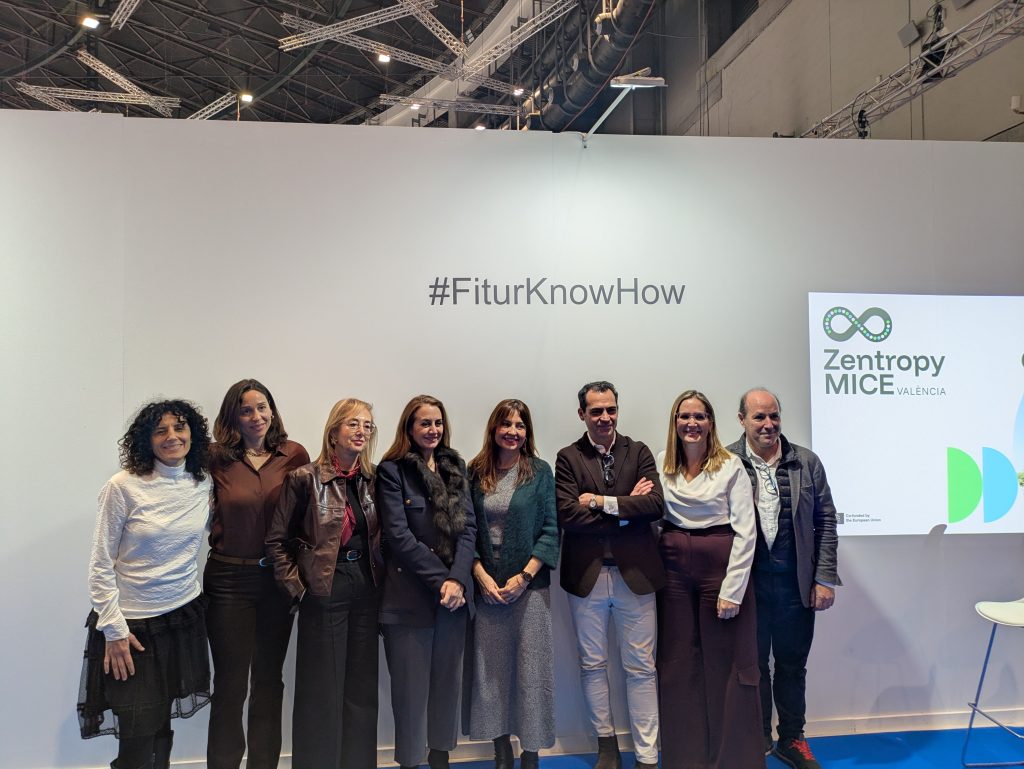
On Wednesday, January 21, Valencia presented the Zentropy MICE project at the International Tourism Trade Fair FITUR. This pioneering European initiative redefines conference tourism by offering a sustainable model based on the concept of urban entropy. Cofinanced by the European Union under the European Urban Initiative, the project proposes integrating the impacts of events into the urban ecosystem of cities to generate real and tangible positive benefits and create a lasting legacy for the city and its residents.
Paula Llobet, Councillor for Tourism, Innovation and Investment Attraction of the Valencia City Council, emphasizes the importance of ‘using Valencia as a pilot city to propose a new way of thinking about and organising MICE events. In this way, we can achieve a balance between economic activity, social cohesion and environmental sustainability’.
Representatives of all the partners involved presented the project and explained the innovative urban entropy model proposed by Zentropy MICE at SEGITTURLab1, located in Hall 12 of IFEMA. This space, inaugurated this year and named the Knowledge Pavilion, has become a strategic hub for the fair, bringing together more than 250 top-level speakers and featuring key sections such as the 1st International Summit on Communication and Tourism.
A model with economic impact and best practices for Europe
Driven by the Tourism and Innovation Department of the Valencia City Council, in collaboration with Valencia Innovation Capital, the Valencia Conference Centre, the Polytechnic University of Valencia, the Visit Valencia Foundation and the urban innovation studio Khora Urban Thinkers, the goal of Zentropy MICE is to achieve a state of ‘zero entropy’, where the impacts generated by MICE events are transformed into a positive return in the form of knowledge, innovation, social cohesion and citizen well-being.
Through nine action programs implemented at the Valencia Conference Centre – which acts as a pilot testing centre -, Zentropy MICE is developing a new model that reduces the environmental footprint of MICE events (consumption of resources, emissions and waste), and maximizes their economic, social and cultural profitability for Valencia and its residents.
The results are evaluated using the Urban Entropy Calculator, a pioneering tool developed by the Universitat Politècnica de València that allows the scientific measurement of the flows generated by events and quantifies their positive returns in terms of knowledge, innovation, citizen well-being and social cohesion.
The sustainable MICE tourism model proposed by Zentropy MICE can be replicated in other European cities that act as learning and transfer partners. Last December, for example, representatives from the municipalities of Ljubljana (Slovenia), Heidelberg (Germany), and Larissa (Greece) visited Valencia to analyze the advantages of implementing this urban innovation model in their respective cities.
Valencia consolidates its leading position in sustainable, digital and innovative tourism
With 967 exhibitors from 161 countries and over 255,000 visitors, the International Tourism Fair Fitur has established itself as a leading meeting point for the global tourism market. The event showcases Spain’s ability to lead in attracting travelers and generate opportunities that drive the industry worldwide.
It is within this context of generating new business models where Valencia leverages initiatives such as Zentropy MICE to consolidate its position as a European laboratory for tourism innovation, ranking as the third Spanish city in MICE tourism. The participation in Fitur underscores Valencia’s commitment to leading the future of sustainable tourism and creating innovation and urban development programs.