
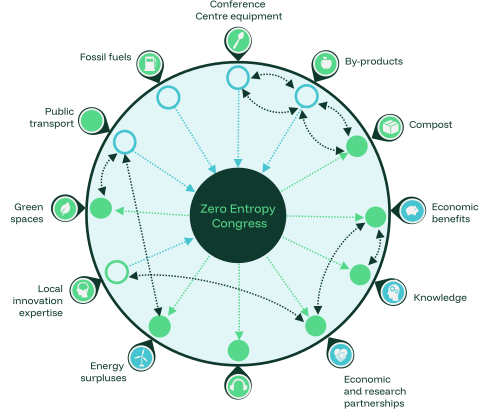
Drawing inspiration from the principles of physics and flow exchange, Zentropy MICE applies the concept of urban entropy to conference tourism. This approach enables the smart management of energy, matter, and information flows circulating between the MICE ecosystem and the city.
Curious to learn how this process works in practice? Keep reading.
The conceptual framework: Entropy flows and the dual MICE experience
The Zentropy MICE approach is grounded in the scientific concept of entropy, understood as the degree of disorder generated within a system when energy, matter and information flow through it.
Applied to MICE events, entropy becomes a powerful analytical lens: it allows cities to understand not only the resource consumption associated with events, but also the broader efficiencies and opportunities they create across urban systems.
A distinctive feature of the project’s methodology is the recognition that a MICE event generates two parallel and interlinked experiences: the Event’s Experience and the Urban Tourism Experience. Together, they represent the full lifecycle of an event’s interaction with the city that does not isolate the event from the urban ecosystem, but rather treats both as part of a single entropic chain:
Regarding the event’s experience, focused on the Valencia Conference Center.
- This environment is controlled, bounded and rich in measurable data, providing highly accurate baselines for analysed matter and energy flows.
- Inputs include energy consumption, HVAC loads, food and beverage services, waste management, logistics, materials, exhibitor operations and staff activities.
Related to the Urban Tourism Experience, taking place across the city during visitors’ free time.
- This space is distributed, diverse and more unpredictable. It encompasses mobility choices, restaurant use, cultural visits, accommodation patterns, shopping behaviour and the visitors’ interactions with the city and the different neighbourhoods.
- While more complex to model, this dimension is essential to fully understand the citywide entropy effects associated with MICE activity.
Urban entropy flows
To operationalise entropy, the project classifies all interactions into three fundamental categories, introducing a quantitative structure that brings objectivity to the process and allows urban flows to be consistently measured across events, venues and destinations. This includes tracking both direct and indirect contributions and ensuring that each flow can be translated into comparable metrics.
- Energy flows: electricity and heating/cooling demand, digital energy use, mobility-related energy, venue operations.
- Matter flows: products, food, materials, waste, water, purchases, and all physical exchanges linked to both events and tourism activities.
- Information flows: knowledge creation, networking, professional connections, local partnerships, and cultural or social exchanges.
This triple-flow model allows for a comprehensive, system-based analysis in which both impacts and benefits can be captured across the event lifecycle. Within this framework, the foundations of the event’s long-term legacy also emerge: energy and matter flows reveal operational and environmental performance, while information flows capture the social and economic value that endures beyond the event itself.
View full article written by Contreras Escribano, Ana (November 28, 2025). Zentropy MICE – Zoom in! Measuring the invisible. PORTICO.